Focused on the operationalization of ML. Developed interactive web-based dashboards using Plotly Dash to visualize model outputs, enabling stakeholders to interact with real-time predictions and data insights.
Comprehensive 48-hour specialization covering the end-to-end Machine Learning lifecycle. Focused on data preprocessing, feature engineering, and deploying classification/regression models. Validated expertise in model evaluation metrics and production-ready ML workflows.
Focused on sequential data architectures, I utilized PyTorch to design and implement Long Short-Term Memory (LSTM) and Gated Recurrent Units (GRU), effectively addressing the vanishing gradient problem to maintain temporal dependencies in complex time-series and natural language tasks.
Implementation of unsupervised learning techniques. Focused on partitioning data using algorithms like K-Means, evaluating cluster validity, and extracting patterns from high-dimensional datasets without prior labeling.
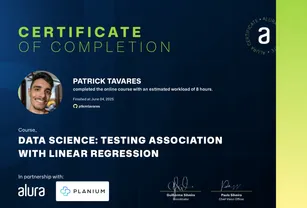
Statistical analysis and predictive modeling. Applied Linear Regression to identify correlations between variables and quantify the impact of features on target outcomes using statistical significance tests.
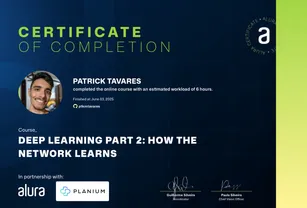
Deep dive into the mathematical mechanics of training. Explored the logic behind backpropagation, gradient descent, and the optimization of loss functions to adjust internal weights and ensure model convergence.
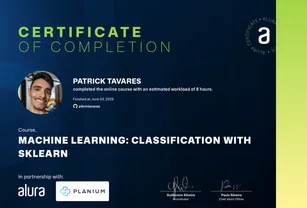
Developed robust classification pipelines using SKLearn. Focused on model selection, cross-validation, and performance metrics (Precision, Recall, F1-Score) to solve multi-class and binary classification problems.
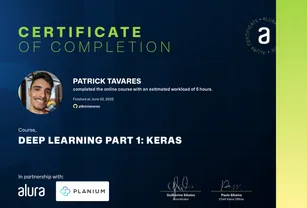
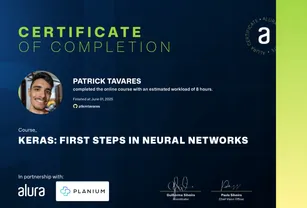
Practical implementation of neural networks using the Keras high-level API. Focused on data preparation, building Sequential models, and executing training cycles for supervised learning tasks.
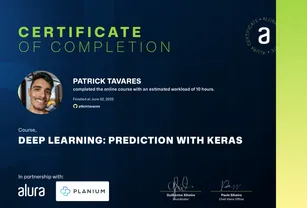
Applied Keras for predictive modeling, focusing on hyperparameter tuning, model evaluation metrics, and optimizing neural networks for high-accuracy forecasting in production environments.
Foundational implementation of neural networks. Covered data preprocessing for deep learning, building sequential models, and understanding activation functions in a supervised learning context.